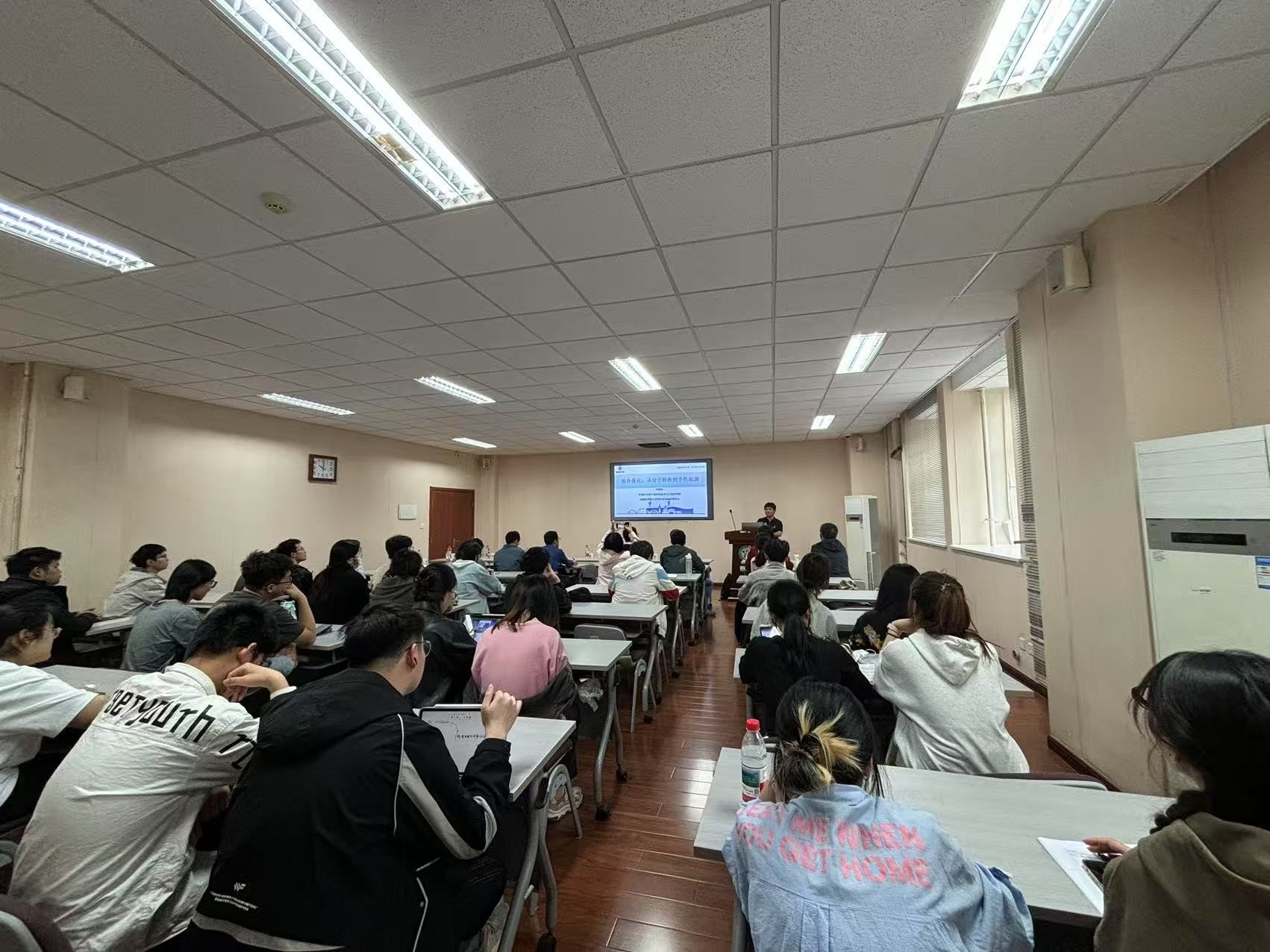
Lecture:Topological Catalysis: From Clean Energy Conversion to the Origin of Life
Prof. Guowei Li from the Ningbo Institute of Materials Technology and Engineering, Chinese Academy of Sciences presented a Maoyi Lecture on April 12, 2025, in the Huaxinglou 226 conference room, under the invitation of the School of Chemistry and Materials Science, entitled “Topological Catalysis: From Clean Energy Conversion to the Origin of Life”. A broad audience of faculties and graduate students from the research areas of inorganic chemistry, physical chemistry, analytical chemistry, and organic chemistry attended the lecture.
Guowei Li is a Professor and Group Leader at the Ningbo Institute of Materials Technology and Engineering (NIMTE), Chinese Academy of Sciences (CAS), and serves as the Chinese Principal Investigator of the Partner Group with the Max Planck Society (Germany). He is also the Deputy Director of the Zhejiang Provincial Key Laboratory of Magnetic Materials and Application Technology. Prof. Li has been selected for prestigious national and institutional talent programs, including the National High-Level Young Talent Program and the CAS "BR Program." His research focuses on the precise synthesis, property modulation, and applications of topological magnetic functional crystals. He has published over 80 papers in renowned journals such as Nature Reviews Physics and Science Advances. He has led multiple research projects, including the NSFC General Program and a commissioned R&D project from the Toyota Group. His accolades include the Emerging Investigator Award from the Royal Society of Chemistry's Journal of Materials Chemistry C and the Outstanding Mentor Award from NIMTE. Additionally, Prof. Li serves as a reviewer for funding programs such as the ACS Petroleum Research Fund (U.S.) and the Macau Science and Technology Development Fund.
In this presentation, Prof. Li firstly introduced two cutting-edge research directions of his Max Planck Society partner group: the interaction between electron spins and the interaction between electron spins and molecules. The discussion then delved into the critical field of catalytic materials, which currently faces design challenges such as complex structures and difficulties in theoretical processing and computational prediction.The breakthrough lies in the application of topological materials, which demonstrate unique advantages in regulating molecular catalysis. Prof. Li and his team achieved precise synthesis of high-quality topological single crystals ranging from millimeter to centimeter scales. Building upon this foundation, they systematically investigated the rapid identification of catalytic active sites through surface electronic states, thereby guiding the discovery of highly active materials. The presentation further progressed from chirality and its origin to the chiral effects of spin-polarized electrons, offering a novel perspective for understanding chirality-related phenomena and pioneering new approaches for designing chiral materials.
In conclusion, Prof. Li provided a concise overview of the UCAS Undergraduate Summer Camp and graduate programs, offering participants comprehensive information that bridged scientific research with student development. Delivered with exceptional clarity and substance, the presentation successfully communicated frontier knowledge in accessible language, leaving faculty and students intellectually enriched. Following the talk, participants engaged in vibrant discussions focusing on key topics including surface state regulation in topological materials, applications of chiral topological structures in spin polarization, and electron spin effects in catalytic reactions. The event concluded with enthusiastic applause, expressing heartfelt gratitude to Prof. Li for this memorable academic feast.