
"Women's/Gender Studies Month" Lecture Series (1) : Sex/Gender Studies across Boundaries: Changes and Challenges
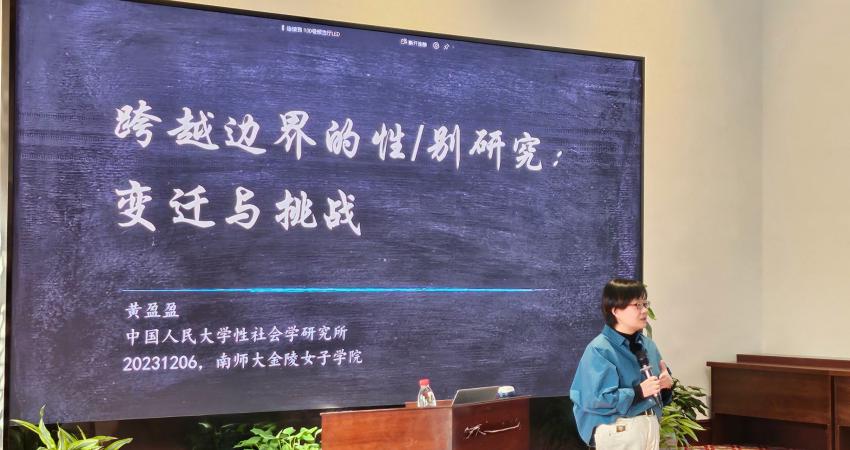
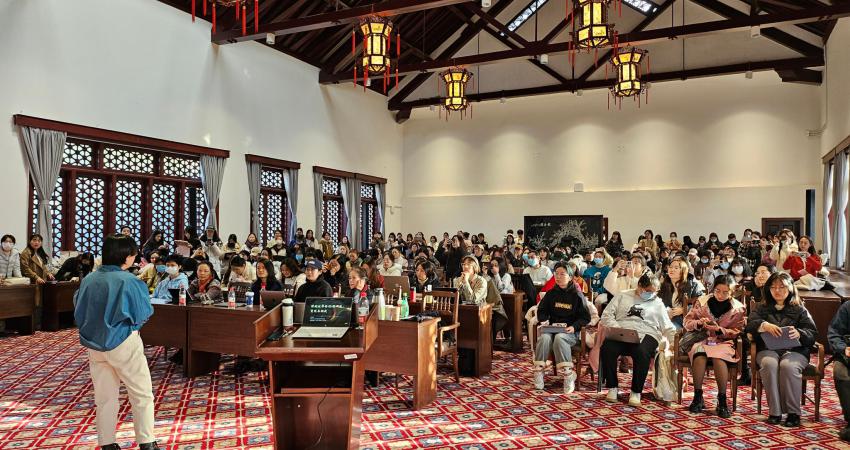
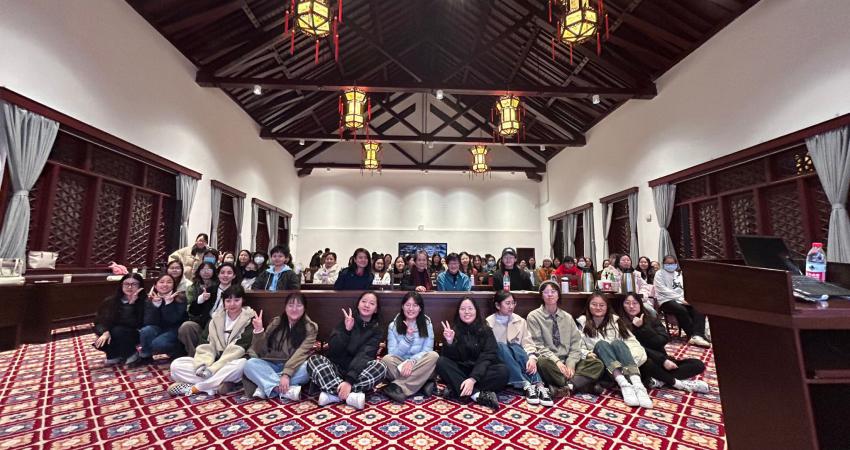
On December 6, the first lecture of Jiangsu Provincical "Women/Gender Studies Month" program in Nanjing Normal University -- "Gender Research across Boundaries: Changes and Challenges" was held at Building No. 100 of Suiyuan Campus, and Ms. Huang Yingying, Professor of the Department of Sociology and Director of the Institute of Sex Sociology of Renmin University of China, was invited as the lecturer. The attendees included not only teachers and students from Ginling College and colleges and departments of Education, Literature, and Social History of Nanjing Normal Univeristy, but also teachers from Jiangsu Academy of Social Sciences and Nanjing Medical University, community social workers, and doctoral students of Sociology from Nanjing University. Ms. Yang Di of Ginling College presided over the lecture.
Professor Huang has long been engaged in the teaching and research of sociology of sex/gender and body, interdisciplinary cooperation of HIV/AIDS, and qualitative research methods, and is the leading figure in related research fields. Her main works include On Method: Local Practice and Sublimation of Sociological Survey (co-authored, 2023/2011), AIDS and the Logic of Life (2019), Sociology of Sex/Gender, Body and Stories (2018), I Am On the Scene: Notes from Field Research in Sociology of Sex (co-authored, 2017), and Sex Change: The Sexual Life of the Chinese People in the 21st Century (co-authored, 2013), Body, Sex, Sexiness: A Study of the Daily Life of Urban White-Collar Women (2008).
Professor Huang started her lecture with Gayle Rubin’s Deviatons and Jeffrey Weeks’s History of Sex to bring forth the questions "Why do we study sex and what to study?" She introduced the significance of sex and sex/gender studies by emphasizing that sex/gender sociology concerns not only the physiological dimension of sex but more on its social and cultural implications and thus should be a vital part in the study of social changes in China.
Professor Huang then helped the audience with a deeper understanding of sex/gender studies by introducing the theoretical knowledge. She detailed the basic concepts in sex/gender studies, the relationship between these concepts and evolution and development of the concepts. Based on the examples of 11 researchers, she explained the paradigms and research turns of sex studies in Europe and America and from the West to the East. She aslo clarified how sex/gender studies evolved from past to present, contributing to a clear plot of the history of sex/gender studies.
Finally, Professor Huang responded to questions about the methodology of sociology studies on sex/gender and the challenges of fieldwork. She suggested that Chinese scholars should pay attention to the localization of sex/gender research in Chinese context, its relevance and differences with related Western disciplines, and the domestic cultural resources. Ms. Huang concluded her lecture with an appeal to the students present to make due contributions to the development of China’s sex/gender studies by focusing more on field research and real situations in Chinese context.
The lecture was highly apprecitated by the listeners, who expressed their admiration for the lecturer’s great expertise, keen analysis and strong academic passion.