Deep Blue Intelligence Academic Salon (4)
On June 24, 2026, the School of Marine Science and Engineering hosted the fourth "Deep Blue Wisdom" Academic Salon in Room 229, Houde Building. Chaired by Professor Fan Yuxin, the session featured presentations by Dr. Li Wensheng, Dr. Ding Teng, and Dr. Huang Xudong from the Geological Environment and Subsea Mineralization research group, who shared their insights on marine mineral resources from various perspectives.
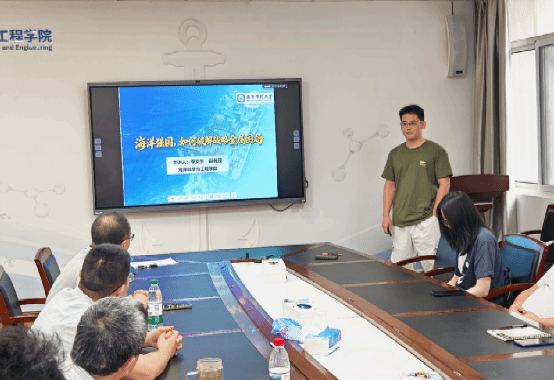
Dr. Li Wensheng delivered a talk titled "Maritime Power: How to Resolve the Strategic Metal Bottleneck." He began with the严峻现状(severe current state)and core challenges facing China's strategic metal supply chain, introduced the distribution of deep-sea polymetallic nodules and cobalt-rich crusts, and explained the metallogenic environments and geological genesis of deep-sea minerals over millions of years. He concluded by proposing the development of a distinctive disciplinary system to support research and teaching, charting a path forward for marine mineral science. Drawing on his own research and teaching experience, Dr. Li offered an in-depth analysis of deep-sea resource development, inspiring a sense of mission among faculty and students to contribute to China's maritime power strategy.
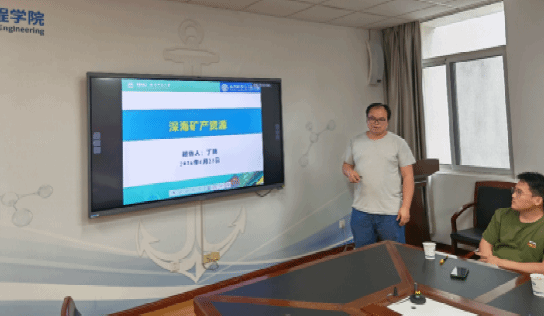
Dr. Ding Teng presented on "Deep-Sea Mineral Resources," systematically covering their types, distribution, formation mechanisms, and current exploration and development status. His talk addressed gas hydrates, ferromanganese nodules and crusts, deep-sea rare earth elements, and seafloor massive sulfides — key alternative sources for land-based critical metals such as copper, nickel, cobalt, lithium, and gold. The unique metallogenic environments also drive interdisciplinary research. While deep-sea mineral exploration is imperative amid land resource depletion and intensifying geopolitical tensions, it still faces significant technological and environmental challenges that require cross-sectoral collaboration.
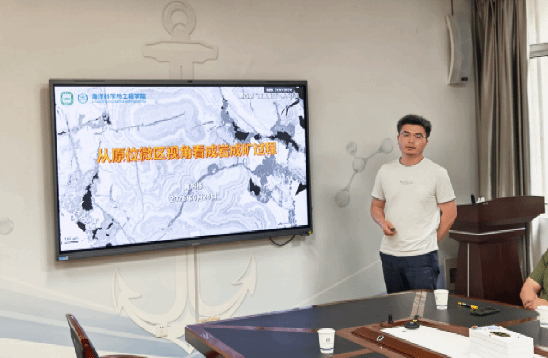
Dr. Huang Xudong spoke on "Diagenesis and Mineralization from an In Situ Micro-Analytical Perspective," offering a methodological overview of metallogenic theory. He began by examining the coupling between mineral resources and metallogenic environments within the framework of plate tectonics, emphasizing that mineral formation results from material cycling and evolution within the lithosphere and the broader Earth system. He then summarized key processes in hydrothermal mineralization through typical deposit models. Focusing on these processes, he elaborated on the application of in situ micro-analytical techniques — such as electron microprobe, LA-(MC)-ICP-MS, and ion microprobe — in metallogenic research, highlighting their crucial role in advancing the study of submarine mineral resources and mineralization.